
Gemologist-appraisers compile many notes as they work, but what happens to those notes and how long should they be kept? GemGuide dives into federal and state legal examples of preservation length as well as ownership and storage guidelines.
The Massachusetts State House had the oldest known United States time capsule. We can thank both Samuel Adams and Paul Revere for its creation. The capsule was a brass box placed in a cornerstone during the building's construction in 1795. A repairman fixing a water leak discovered it in 2014. It was decided that since it may have been exposed to possible water damage, it should be opened. Among the treasures was a silver plaque that was possibly made by Paul Revere!1
Appraisers also create time capsules. Not just in the appraisal reports they render, but also in their working or field notes. The question is, how long should a gemologist-appraiser preserve these notes?
Standards
The first stop for seeking a guideline to the preservation length is to consult with the Uniform Standards of Professional Appraisal Practice. For general notes, USPAP suggests,
"An appraiser must maintain the work file for a period of at least five years after preparation or at least two years after final disposition of any judicial proceeding in which the appraiser provided testimony related to the assignment, whichever period expires last."2
Notice that it does not state the appraiser must destroy the notes at the end of the stated time frames. Thus, you can maintain the notes for long as you want and still be following USPAP.
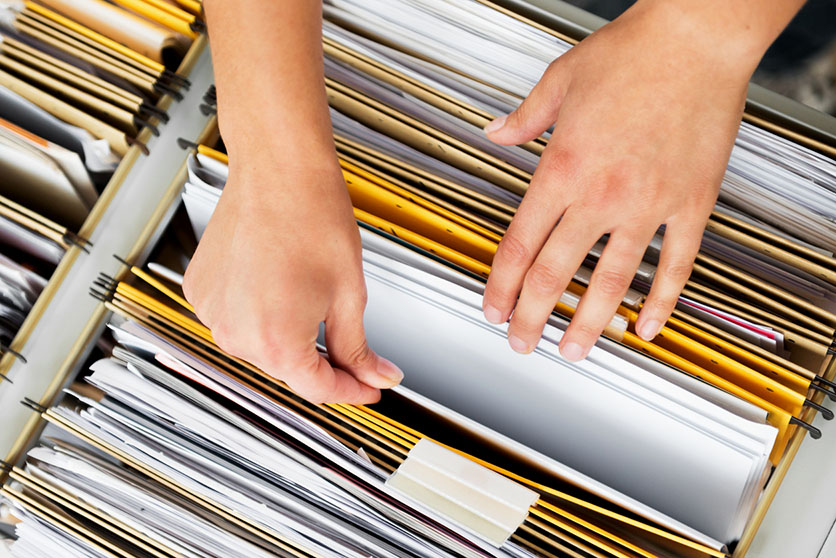
There are basically three gemologist-appraiser scenarios: those who directly enter information into an appraisal program and have no written notes, those who write notes and preserve the papers in a file cabinet, and those who scan their written notes and preserve them electronically.
Always keep in mind client confidentiality when preserving notes. To stow them in a file cabinet that can be accessed by unauthorized persons is a no-no. The same goes for electronic files. Beware of using any electronic storage that can be hacked by computer gurus. Imagine how excited a thief would be to have a detailed list of jewelry and addresses! You could not call and forewarn your clients since you do not have the stolen files.
Noteless Updates?
Insurers have recommended an update of the commonplace appraisal for obtaining insurance every two to five years. Do you really want to update an appraisal without first reviewing the working notes? After all, instrumentation and testing techniques are a moving target in today's world. Thus, we may now have a working notes preservation period of at least five plus years.
Expert Witnessing
Gemologist-appraisers who testify as expert witnesses soon discover the legal pre-trial exchange of evidence between parties, called discovery:
"Trial practice. The pre-trial devices that can be used by one party to obtain facts and information about the case from the other party in order to assist the party's preparation for trial."3
We can see from the federal requirements that one must be able to submit,
" . . . a list of all other cases in which, during the previous four years, the witness testified as an expert at trial or by deposition . . . "4
Although the laws vary among states, similar laws to the federal law exist. For example, Minnesota,5 Iowa,6 and Tennessee7 require the same exact disclosure of expert witnesses. Montana, on the other hand, does not have the four-year rule.
If any previous testimony under oath is challenged by the opposition, you may need your working notes to avoid being harshly cross-examined because you cannot remember the details. At least preserve notes for four years.
Date of Discovery
There exists a statute of limitations. One cannot sue after a certain time has elapsed.
"A statute prescribing limitations to the right of action on certain described causes of action or criminal prosecutions; that is . . . no suit . . . unless brought within a specified period of time after the right accrued."8
In essence, there is a statute of limitations if an appraiser is legally challenged for messing up an appraisal. It's when the affected party discovers the problem that the clock starts to tick. An unpublished New Jersey Superior Court case stated in the headnotes,
"Under the discovery rule, a jewelry store owner's claim against an appraiser alleging undervaluation of jewelry, which was to be used to pay off a judgment debt, accrued, for purposes of the six-year statute of limitations, on the date the owner filed a suit in federal court alleging undervaluation of the jewelry. It was at that time that the owner was aware of his claim."
And the court concluded that,
" . . . plaintiff's remaining claims, for the undervaluation of his property, would be governed by the six-year statute of limitations . . . according to plaintiff's complaint, defendants appraised the jewelry in May 1999. As such, the statute of limitations began to run from this date and expired six years later in May 2005. Plaintiff filed his complaint in August 2009, over 10 years from the date [name redacted] completed the appraisal. Thus, plaintiff's complaint is barred by the statute of limitations absent equitable tolling or a showing that the cause of action accrued at a later date."9
So, we can see the statute of limitations was six years and the clock started ticking upon discovery of the problem, not when the appraisal was rendered. Should we retain working notes for at least six years?
Who Owns Working Notes?
The odds of being sued or brought into a case that requires lengthy time periods for preservation of working notes are unusual. However, one must ask if the appraiser or the client owns the appraisal working files. A non-precedent-setting case10 involved an appraiser's estate, as specified in Art Law - The Rights and Liabilities of Creators and Collectors,11 in which the clients of the deceased appraiser protested to the court questioning the ability of the personal representative of the estate to assign the working files to an heir. In other words, it raised the question of who owned the appraiser's working files - the clients or the appraiser? The court concluded,
" . . . the court finds that the copies of the appraisals done by Mr. Hall are not the property of the estate but of the clients of Mr. Hall and were therefore properly excluded from the inventory by the personal representative. The appraisals therefore should be properly disposed of by the personal representative in a manner designed to protect their confidential manner."12
Can an appraiser be sued for destroying the property of their client?
Gemologist-appraisers are "providers of opinion information," as are accountants. Thus, laws that affect accountants and auditors may or may not affect appraisers, but we can learn from them.
Most states have this law, detailing that a licensee (the accountant) owns,
"All . . . working papers . . . incident to, or in the course of, rendering services to a client in the practice of public accountancy . . . shall be and remain the property of the licensee . . . No . . . working paper . . . shall be sold, transferred, or bequeathed, without the consent of the client or his or her personal representative or assignee, to anyone other than one or more surviving partners or stockholders or new partners or stockholders of the licensee, or any combined or merged firm or successor in interest to the licensee."13
The above law basically states the working files belong to the accountant, but cannot be sold, inherited, or otherwise transferred outside the firm with which the client did business. However, rather than wonder if these laws will be used if an appraiser is involved, the safe approach is to use the benefit of a contract. The contract should state that the files are the property of the appraiser and he or she has the right to destroy the files after a certain time span.
Keep Them Forever
As a gemologist-appraiser, you may now decide to preserve your working notes, photographs - basically everything related to the appraisal - for as long as you are in business. "I keep my notes forever," La Shawn Bauer, GIA GG, NAJA SM, asserted about all suggested work file destruction time spans. "It is like a secret bank account that will pay out some unexpected money in the future with an expert witness opportunity."
Written by Bill Hoefer

|

|

|
|

|
|
1. Andrews, E. (2016, March 7). America's Oldest Known Time Capsule Was Made by Paul Revere and Samuel Adams. History.
https://www.history.com/news/8-famous-time-capsules. Back to Text ↑ ↑ ↑
2. 2021-2022 Uniform Standards of Professional Appraisal Practice (USPAP), Page 10, Line 282. Back to Text ↑ ↑ ↑
3. Black's Law Dictionary, Fifth Edition, Page 419. Back to Text ↑ ↑ ↑
4. Federal Rules of Civil Procedure, Rule 26. Duty to Disclose; General Provisions Governing Discovery (a)(2)(B)(V). Back to Text ↑ ↑ ↑
5. Minnesota Rules of Civil Procedure, Rule 20.01/ Required Disclosures (b)(2)(E). Back to Text ↑ ↑ ↑
6. Iowa Rules of Civil Procedure 1.500(2)(b)(5). Back to Text ↑ ↑ ↑
7. Tennessee Rules of Civil Procedure, Rule 26.02(4)(A)(i). Back to Text ↑ ↑ ↑
8. Black's Law Dictionary, Fifth Edition, Page 835. Back to Text ↑ ↑ ↑
9. 2020 WL 4007653. Back to Text ↑ ↑ ↑
10. Estate of Hall, No. 81-155 - P. Ct., Piscataquis, Me., Aug. 8, 1983. Back to Text ↑ ↑ ↑
11. Art Law - The Rights and Liabilities of Creators and Collectors, by Feldman, Weil and Biederman, Little, Brown, and Company, 1986, Page 546. Back to Text ↑ ↑ ↑
12. Ibid, page 547. Back to Text ↑ ↑ ↑
13. California Business and Professional Code, Division 3, Chapter 1, Article 2, § 5037(a). Oregon Revised Statutes, Title 52, Occupations and Professions, Chapter 673.380(1). Minnesota Statutes, Trade Regulations, Consumer Protection, Chapter 324-341, § 326A.13 (a). (To cite a few states). Back to Text ↑ ↑ ↑
14. Published in Gem Guide, November-December 2024, Volume 42, Issue 5, pages 20-22.
15. Illustrations - IStock.com.