
Market activity is driven by supply and demand, which can fluctuate at the same time but will eventually balance out. Appraisers must understand the principles and how they affect prices when seeking value.
Imagine gladiators dueling on a seesaw in the Roman Colosseum. Two naked criminals with their hands bound behind them were attached to the seesaw. They could bounce each other up five meters in the air. Each criminal would try to be up in the air safely away from the carnivorous animals that were released by bouncing the other guy to the ground. However, there were no winners; the moment the first criminal was killed, the mere lack of weight dropped the second prey to his doom.1
The seesaw of supply and demand is not as entertaining. Nevertheless, appraisers must understand the basic principles to discover and report the perfect value.
Take a Price Break
In a marketplace, if there is a demand that outpaces supply, prices for the service or goods will increase. Likewise, if supply is greater than demand, then the prices will decrease. Even if consumers want to buy more of what is not available or suppliers want to sell more than buyers wish to acquire, this seesaw between supply and demand will eventually come to a balance. Supply will meet demand to create what economists call an equilibrium price. This is the perfect value.
Buyers or sellers become exasperated if equilibrium price does not exist. In essence, providers of products or services desire to sell more than consumers want to buy whereas consumers long to buy more of what is in short supply.
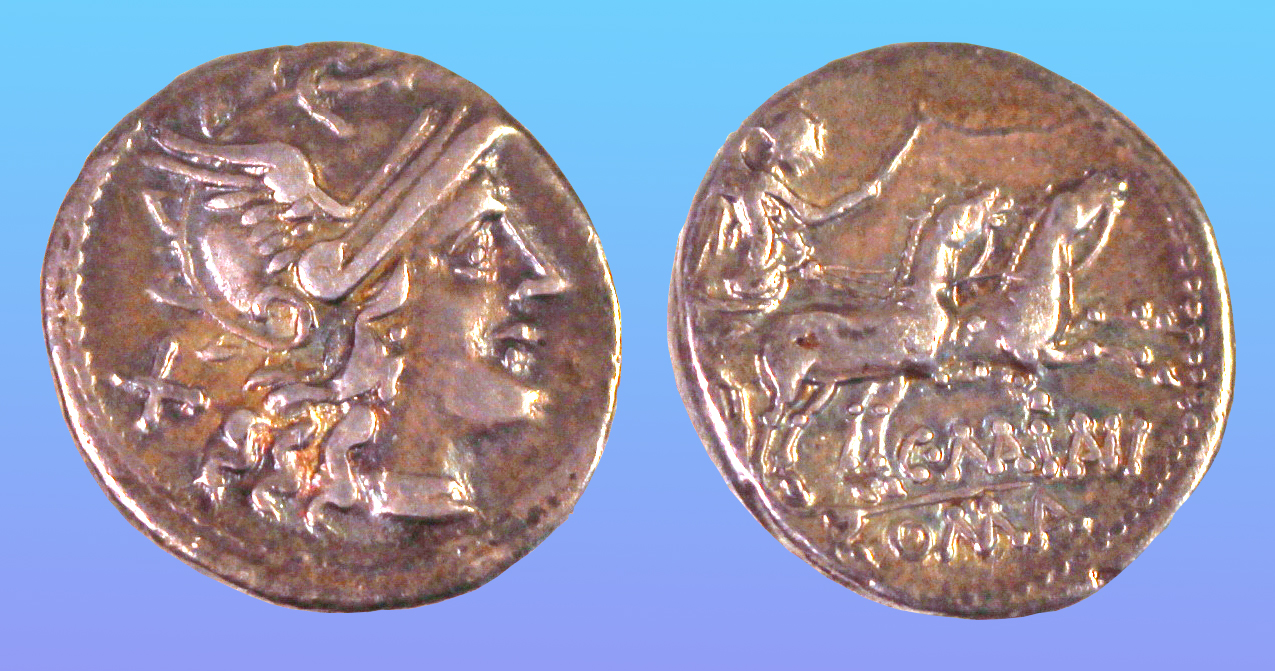
Roman Silver coin, called an AR Denarius, issued 153 BCE, of Roma wearing a winged Corinthian helmet wuth a reverse depicting Victoria in biga, holding reins and whip. Engraver Caius Maiabius, owned by author.
If there is not an equilibrium price, the market will naturally gravitate toward one, and then a state of market rest will occur. Any increase in supply or demand will cause the market to gravitate and balance.
"Regardless of the market adjusting to achieve equilibrium," cautioned La Shawn Bauer, GIA GG, NAJA SM, "the effective date (date of value) dictates when to determine the value. Predictions are not acceptable."
Just How Scare?
If prices are below the equilibrium price, then consumers will acquire more of a service or product. This is described as a shortage or excess demand. Keep in mind that a shortage is not the same as scarcity because any product that is scarce creates market activity through demand. A shortage occurs when scarce items are in excessive demand.
If rubies are being sold at a price that is below the equilibrium price, consumers will acquire more of them. Thus, rubies become scarce. The low prices increase demand, but the supply cannot increase. This is called excessive demand. Buyers will drive the market towards an equilibrium price by paying more when a shortage occurs.
Overflowing Equilibrium Price
When the prices of goods and services are above the equilibrium price, that ends in a surplus of goods. Excess supply is the difference between the quantity of goods supplied and the quantity of goods demanded. And, as in any market imbalance, the market will move towards an equilibrium price.
An oversupply will drive prices lower, which in turn encourages consumers to purchase more since the prices are low or being discounted. This will happen even if consumers do not need the product or service. Consumers include retailers, professional buyers, etc., as well as consumers that will shop around for the best prices because the purchase will impact their budgets.
Unlike the seesaw metaphor, supply and demand can rise and fall at the same time.
Related Products or Services
A disturbance of a product or service's equilibrium price will upset the equilibrium price of related products or services. The over supply of lab-grown diamonds resulted in lowering prices, and that directly affected natural diamond prices. Thus, complements or substitutes are usually affected. An appraiser needs to understand these relationships in seeking values.
Time Flew
Transition costs are also at play. The time it takes a seller to seek out a buyer, for example. Sometimes this is temporary. Nonetheless, the result is the best price for both. As an appraiser, you must beware of transition costs. You should not compare retail stores with high costs of seeking buyers with stores that do not have such costs.
When there is too little time to determine a shift in the demand or supply, transition costs will occur. A fossil show attended by worldwide collectors and scientists is held in a rural town. It seems that everyone wants to wear a T-shirt that states, "I Dig Old Bones." The price of T-shirts will increase, as will the service fees to imprint them, due to the demand. The prices will drop back to normal as soon as the show ends. This is a transitory shift in demand, which is often random at times.
In most appraisal assignments, you must not base your value conclusion on truly transitory shifts in demand or supply.
Written by Bill Hoefer

|

|

|
|

|
|
1. Oliver, M. (2016, November 25) 10 Crazy Shows Romans Could Watch at the Colosseum.
https://listverse.com/2016/11/25/10-crazy-shows-romanscould-watch-at-the-colosseum/ Back to Text ↑ ↑ ↑
2. Published in Gem Guide, January-February 2025, Volume 44, Issue 1, pages 17-18.
3. Article illustrations by Bill Hoefer.
4. Other illustrations - IStock.com.