
RINGS ENGAGED to be MARRIED - Gem Guide, May - June 2009
One of the most commonly encountered appraisal assignments is to value a bridal set. However, appraisers have differing approaches to appraising the engagement set.
High Priest with a Torch
If a goldsmith, without even the benefit of a ceremony, marries an engagement ring to a wedding band, this priestly act leaves appraisers little choice but to value them as one item. Nobody disputes determining the worth for married sets as if they were one unit even if the rings are terribly mismatched. This is not an issue for rings that are soldered together. However, in instances where the two rings comprising the set are still separate, should they be appraised as two items, or one?
Those appraisers that describe, list and value the wedding band separate from the engagement ring defend such an approach as warranted by the way insurance works. However, appraisals rendered by advocates of describing, listing, as well as valuing the engagement ring and associated wedding band as one unit point out that insurers readily accept such valuations. Which approach is correct?
Reporting from the Trenches
Raymond Mason, C.E.O. of Arizona Gemological Laboratory, Inc., values unsoldered wedding sets as two items. "Appraising them as a set with one value should only occur if they are soldered together." He added precision to his statement by explaining that the main reason for appraising unsoldered wedding sets as individual pieces is so the insurance company can know what the value is for that piece and make the client whole again in the event of a casualty loss.
Appraiser Deborah Villepique explained her approach this way. "When a bridal set is not soldered together, I appraise them as separate items. Since rarely are both rings lost together and thus separate values make sense." This view is consistent with the approach that many appraisers take when valuing a set recognizing that in a casualty loss, it is most like ly that one item will be lost, not both.
"They should be appraised as one item if they are a matched set," counters Bernard Doris of Bernard Doris and Company, Personal Property Appraisers in Augusta, Georgia. He bases his approach on the 'pair and set' clause that is found in marine and inland marine insurance policies. "If they are matched, fitted or a shadow band, for example, then they are valued as a unit," agrees Eileen Eichhorn, owner of Eichhorn Jewelry, Inc., Decatur, Indiana. She added that cufflinks, which are sold and bought as a pair, are appraised as a unit - then so must a matched wedding set.
Some unnamed appraisers admitted that they could get more money if they did the rings separately rather than as a set. A few suggested that it might be a standard of the National Association of Jewelry Appraisers (NAJA). Of course, if the widely recognized NAJA has such a standard, then the next logical step would be to study that standard. "It is definitely not a NAJA standard," answered Gail Brett Levine, Executive Director. However, she went on to say that she personally appraises bridal sets as two items, not one. "If a casualty loss occurs and just one item is lost, how do you break out the value for that one item if the two pieces are valued together as one?" she explained.
What About the Insurer?
To understand the policies of insurance companies, one must realize that the insurance contract type is based on the way a full casualty loss is handled. With the omnipresent actual cash value policy, the value is calculated when a casualty loss occurs. An actual cash value policy determines value at the time of the loss in order to indemnify the insured. On the other hand, if the value was pre-agreed, then an agreed value policy is involved. If the engagement set is lost then a check will be sent for the agreed amount. If a partial loss occurs, then the indemnification will follow the way actual cash value policies function.
Therefore, it seems that in either case, if part of the set were lost, the insurance company has a procedure for calculating the amount necessary for indemnification. However, there is one more factor to consider- the 'pair and set' clause that Bernard mentioned as the reason for his appraising the set as one.
Pair and set clauses limit the insured from being overcompensated. If, for example, one earring is lost, the insurer does not have to replace the pair. They can merely pay the value for the one missing earring. The insurer has a choice to pay off the set or the one component of the set. Some insurers have set themselves above the average insurer by embracing broad pair and set clause responsibilities. They will replace the pair or set if the owner relinquishes the sole survivor of the casualty loss. Do pair and set clauses apply to engagement sets?
"If the wedding set consists of two rings not meant to be together, they need to be valued separately," advises Anne Blumer, an independent appraiser specializing in insurance methodology. "But two rings that are definitely meant to be a set will be insured under the pair and set clause."
It's All in the Timing
Couples do not always buy their ring set in one transaction. The man may buy the engagement ring, have it appraised and then later on purchase the band. In such a case, there can exist two appraisals for the bridal set. Here, the insurer will accept bridal sets appraised separately even if they should have been valued as one. Deborah Villepique makes it clear that an additional fee would be involved if they want them appraised together as a set if they had brought the engagement ring in at a different time.
The Conclusion
If the set is soldered together, then it is prudent to appraise them together with a single value conclusion. However, if the paired items were not designed as a set, then value them as two items in the appraisal.
If the items were designed as a set, then the most acceptable approach is to appraise them as a unit with one value conclusion. However, regardless of how you ultimately choose to appraise these, the insurance company will typically accept either one value or separate values for the engagement ring and wedding ring set.
Written by Bill Hoefer

|

|

|
|

|
|
1. Published in Gem Guide, May-June 2009.
2. Illustrations - IStock.com.
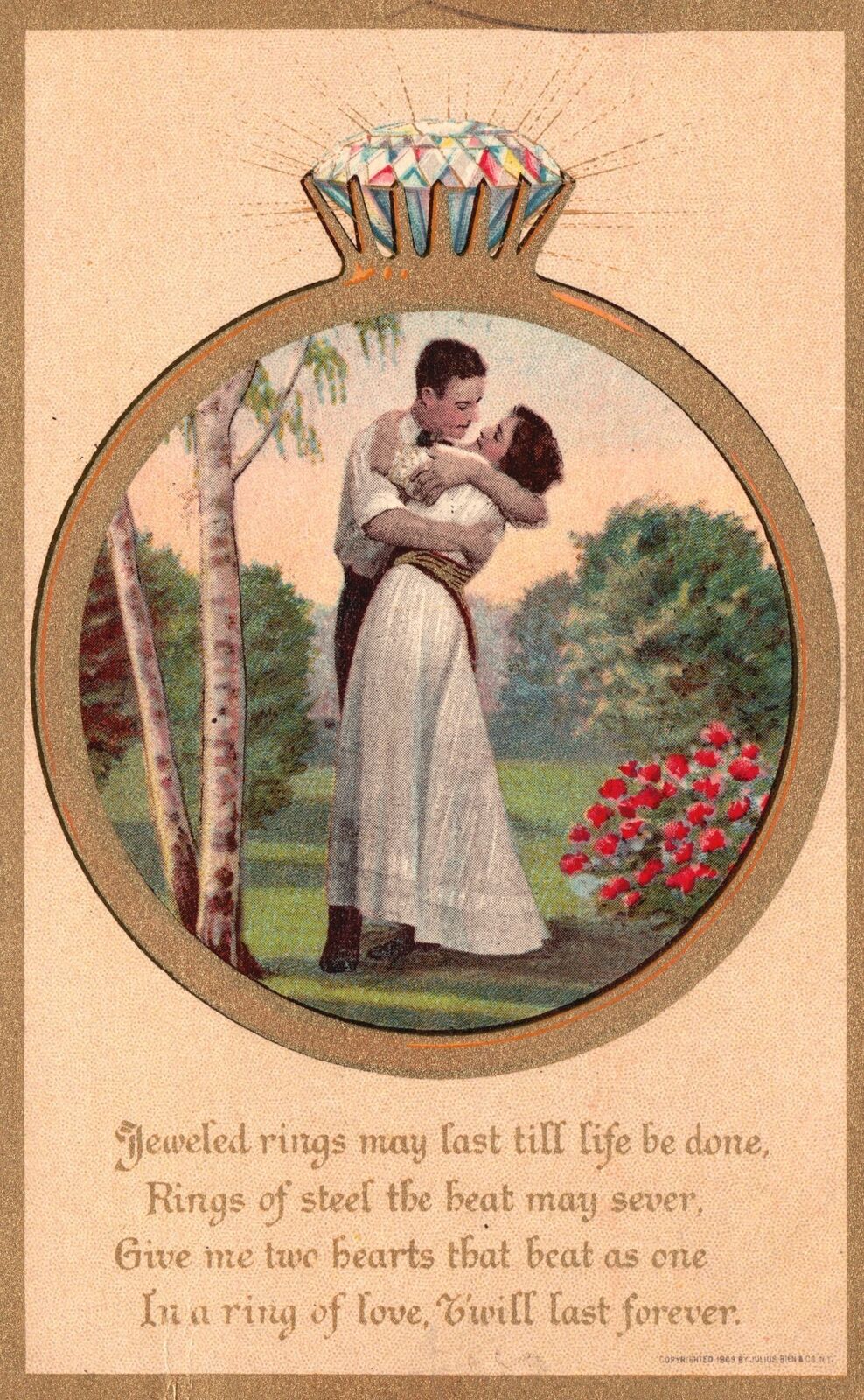
3. Illustration - Antique post card owned by author.