
Are appraisers liable to third parties? It depends on the state. Here's what’s important to know.
"The services of experts are sought because of their skill. They have a duty to exercise the ordinary skill and competence of members of their profession, and a failure to discharge that duty will subject them to liability for negligence. Those who hire such persons are not justified in expecting infallibility, but can expect only reasonable care and competence. They purchase service, not insurance."1
Appraisers are considered experts.
Who Is Who?
One needs to understand that in the legal arena, there are parties. These parties offer no cocktails - "parties" are legal parlance. If someone renders an appraisal for a ring, for example, then they are the first party. The client is a second party. And the end user is a third party. If the appraisal is intended to be used for securing insurance and that occurs, then the insurer is the third party. However, even if the appraisal was to be used for securing insurance, and the client uses it to sell the item to a neighbor, the neighbor is the third party.
Is an appraiser liable to third parties?2 It depends on which state has jurisdiction.
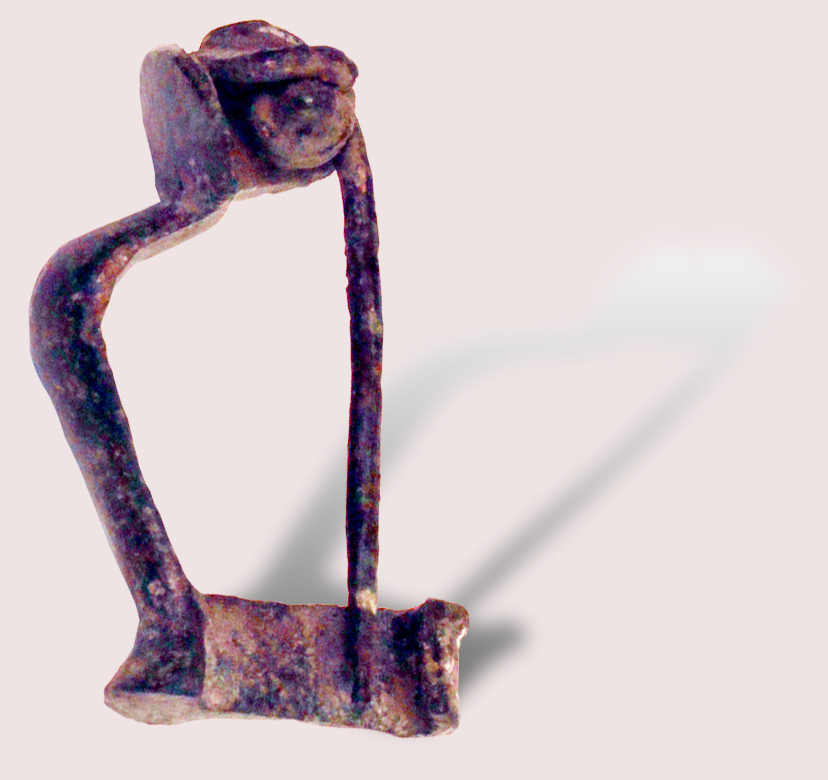
Roman fibula made of brass, circa 100 A.D., owned by author.
Foreseeable Approach
Something is foreseeable whenever it " . . . should reasonably have anticipated danger to others created by his negligent act . . . "3 Three states (New Jersey, Mississippi, and Wisconsin) embrace the idea that an unspecified third party can sue an appraiser. Thus, the neighbor who is not an insurance company can sue the appraiser.
A Wisconsin published case made it clear when it stated, "Thus, under well-settled principles of Wisconsin negligence law, an appraiser may be held liable to a third party for negligence in performing an appraisal."4 Although there are only three "foreseeable approach" states, most appraisal courses, society standards, and publications inappropriately embrace and promote this legal theory. If one practices in a "foreseeable approach" state, it's time to add contract disclaimers recommended by one's attorney.
Forseen Approach
Most jurisdictions5 follow the legal theory that third parties that can sue an appraiser are those for whom the report was intended. If the appraisal is to be used for obtaining insurance, then an insurance company (third party) can sue the appraiser if he or she is negligent. However, if the appraisal was used to sell the item, the buyer cannot sue the appraiser. Foreseen approach is basically " . . . a general principle that one who negligently supplies false information 'for the guidance of others in their business transactions' is liable for economic loss suffered by the recipients in justifiable reliance on the information."6
The foreseen approach is fine-tuned by limiting liability to two types of third parties, namely third parties specifically known by the appraiser or known third parties who are considered a class of people who will rely on the appraisal report. It is not required that the third party be named in advance. A California case stated, " . . . it is sufficient that the third party belongs to a particular group or class which the information was intended to benefit."7 However, the appraiser would have to know that a third party exists prior to rendering the appraisal report.
Do not be vague when stating the assigned use of the appraisal. Do not, for example, state "for insurance and other purposes." Likewise, do not state "to whom it may concern."
Privity Approach
Privity is defined as "that connection or relationship which exists between two or more contracting parties."8 There are states9 that, unless a third party can demonstrate privity, do not allow third parties to sue an information provider. New York published a precedent-setting case about when third parties can sue a provider of opinion information. "Before accountants may be held liable in negligence to noncontractual parties who rely to their detriment on inaccurate financial reports, certain prerequisites must be satisfied: (1) the accountants must have been aware that the financial reports were to be used for a particular purpose or purposes; (2) in the furtherance of which a known party or parties was intended to rely; and (3) there must have been some conduct on the part of the accountants linking them to that party or parties, which evinces the accountants' understanding of that party or parties' reliance."10 An interaction between an appraiser and an insurer would satisfy the third requirement. Instead, appraisers who maintain strict client confidentiality would not meet the third requirement.
How to Crash a Party
This is a diversity of citizenship case. " ... When the party on one side of a lawsuit is a citizen of one state, and the party on the other side is a citizen of another state, or between a citizen of a state and an alien."11 The insurance company was a Great Britain insurance company. A partial casualty loss took place and then the stolen property was recovered, and it was discovered that the appraiser had valued the artifacts for 10 times their value - $4,054,800 for the entire collection, $200,000 for the portion stolen.
The federal court had to decide which state's laws would apply. Was it to be New Jersey, a foreseeable state, or New York, a privity state? The appraiser's actions mostly took place in New York, thus the court decided, "As an initial matter, this court must determine which state's law is applicable to the instant action. [Name redacted] claims that New Jersey law applies to this action. Such a choice of law would be favorable to the plaintiff in that New Jersey law, unlike New York law, does not require privity in actions for negligent misrepresentation. In determining which jurisdiction's law is in fact applicable, this court must apply the choice of law rules of New York."12
The insurer was not able to sue under New York law. But, wait . . .
With privity, to satisfy the third requirement - that a special relationship between the appraiser and the plaintiff must exist - the insurance company's attorneys discovered a statement in the appraisal certifying that it was made " . . . in accordance with the ethical code of the [society name redacted]." That code sets forth an appraiser's duty to third parties. Specifically, Section 3.6 provides: "It frequently happens that an appraisal report is given by the client to third parties for their use. These third parties may or may not be known to the appraiser but, regardless of this fact, they have as much right to rely on the validity and objectivity of the appraiser's findings as does the client. Members of the society recognize their fiduciary responsibility to those parties, other than the client, who make use of their report."
Thus, although [appraiser's name redacted] did not know precisely which insurance company would ultimately rely on his representations, there was apparently a fiduciary duty owed by [appraiser's name redacted] to that company. Such a duty could create a relationship which satisfies the third criterion.13
Fiduciary?
A court stated the following concerning fiduciary duty and responsibility: "Mere subjective trust, however, is not enough to transform arms-length dealing into a fiduciary relationship."14 Although the case was about an auditor, the legal arena views them as providers of opinion information. And appraisers are also providers of opinion information. If no fiduciary relationship exists between an appraiser and second party, then there does not exist such a relationship between an appraiser and third parties.
The society ethical standards allowed the insurer to sue the appraiser. Gulp!
Written by Bill Hoefer

|

|

|
|

|
|
1. 43 Cal.2d 481, 275 P.2d 15. Back to Text ↑ ↑ ↑
2. This article does not provide any legal advice. Seek the services of an attorney. Back to Text ↑ ↑ ↑
3. Black's Law Dictionary, Fifth Edition, page 584. Back to Text ↑ ↑ ↑
4. 123 Wis.2d 410, 366 N.W.2d 896. Back to Text ↑ ↑ ↑
5. Alaska, Arkansas, California, Florida, Georgia, Hawaii, Illinois, Iowa, Kansas, Kentucky, Louisiana, Michigan, Minnesota, Missouri, New Hampshire, New Mexico, North Carolina, Ohio, Rhode Island, Tennessee, Texas, Utah, Washington, West Virginia, and the federal government. Back to Text ↑ ↑ ↑
6. Restatement of Torts, Second § 552, com. h, pp. 132-133. Back to Text ↑ ↑ ↑
7. 44 Cal.App.4th 1760, 52 Cal.Rptr.2d 635. Back to Text ↑ ↑ ↑
8. Black's Law Dictionary, Fifth Edition, page 1,079. Back to Text ↑ ↑ ↑
9. Alabama, Delaware, Idaho, Indiana, Montana, Nebraska, New York, and Pennsylvania. Back to Text ↑ ↑ ↑
10. 493 N.Y.2d 443; 483 N.E.2d 118. Back to Text ↑ ↑ ↑
11. Black's Law Dictionary, Fifth Edition, page 429. Back to Text ↑ ↑ ↑
12. 688 F.Supp. 910. Back to Text ↑ ↑ ↑
13. Ibid. Back to Text ↑ ↑ ↑
14.715 S.W.2d 408. Back to Text ↑ ↑ ↑
15. Published in Gem Guide, March-April 2025, Volume 44, Issue 2, pages 15-16.
16. Article illustrations by Bill Hoefer.
17. Other illustrations - IStock.com.