
The second of a two-part series looks at the state laws that exist surrounding the sales of ivory. For the first part, revisit November/December 2023 issue.
The states that have enacted laws about ivory are in concert with allowing ivory possession, inheritance, and so on. This translates to the gemologist-appraiser being able to render appraisals for obtaining insurance, insurance casualty loss, inheritance, probate, estate tax liability, trusts, and several other commonplace assignments. Resale and comparison for purchase may or may not be necessary. Be certain to include specific limiting conditions to narrow down the assignment.
What about the states that did not enact ivory laws in support of the Convention on International Trade in Endangered Species of Wild Fauna and Flora treaty? The states not specifically detailed herein allow the buying and selling of ivory if it was legally in the state before February 26, 1976 (African elephant ivory) or July 1, 1975 (Asian elephant ivory),1 but only within that state (to be certain, though, check with your attorney as this column isn't intended to be legal advice). Thus, circa dating worked ivory is an important part of the gemologist-appraiser's task, even within states where there are no derivative federal and international enacted restrictions. Either circa date the ivory or clearly state you could not do so.
Possession and Inheritance OK
Most states with specific laws about ivory allow possession, inheritance, and donation to authorized entities. Hawaii is one state that allows one to donate to a bona fide educational institution or museum, or for scientific study.2 The land of Lincoln, Illinois, lets one inherit ivory that is part of an estate upon death or in anticipation of death if they are a lawful beneficiary.3 New York follows suit and allows for the distribution of the ivory article to a legal beneficiary of a trust, or to an heir or distributee of an estate.4 And New Jersey accepts transfer of ownership of ivory that is part of an estate being conveyed to lawful beneficiaries upon the death of the owner or in anticipation of that death.5 New Hampshire also allows inheritance of ivory.6
Evaluating Parts
The federal level has an exception of concern to gemologist-appraisers: the antique exception. Ivory that qualifies as an antique - 100 years or more in age - is exempt and can be sold between states. Some states also included the antique exception, with antique being defined as 100 years old, but added percentages of ivory. Thus, in California the ivory must be 5% by volume or less.7 Hawaii limits the ivory volume to 20% by volume.8 Illinois requires documentation if the item is an antique, with the usual 100 years requirement,9 and the volume limit is 20% .10 New York defines a bona fide antique as 100 years old, but it is only legal to sell if 20% or less ivory. Age can be established by the owner with historical documentation.11 Oregon requires the 100-year-old age be established by the owner or seller through documentation and limits the ivory to a total weight of less than 200 grams.12 New Hampshire supports the 100-year antique exception but requires documentation.13
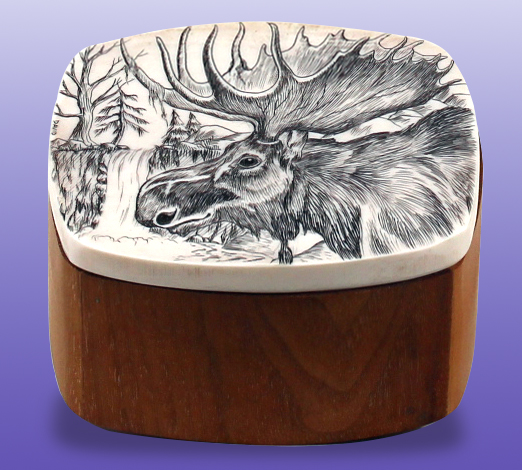
Ivory Box, owned by author.
Primary Source of Value
Hawaii requires that the ivory is a fixed part of a larger manufactured item, and the ivory cannot be the primary source of value.14 And in Illinois, the ivory must be a fixed part of the antique. Additionally, the ivory cannot be the primary source of value, and, if true, that must be included in the valuation report.15
Fossil
Although gemologist-appraisers can determine if ivory is fossil or not, state legislators assumed the identification is too risky. Hawaii bans mammoth ivory,16 but the law did not mention mastodon ivory. A license must be obtained from the New York State Department of Environmental Conservation to sell ivory.17 There is no fee, but the ivory must predate 1976, and the license needs renewing each year. It is the required inventory form for the NYSDEC that brings to light some interesting requirements. Strangely, the form makes it clear that antique ivory cannot have been repaired with elephant ivory after December 27, 1973, or mammoth ivory after June 30, 2014. Illinois defines ivory very broadly: "'Ivory' means any tooth or tusk composed of ivory from any animal, including, but not limited to, an elephant, . . . mammoth . . . "18
Value-Based Punishment
California has penalties, and they vary by how many offenses occurred, with "total value" as a variable.19 This is an appraisal opportunity, and "'Total value' means either the fair market value or the actual price paid for ivory . . ., whichever is greater."20 The effective date will be the date of incident. The Fish and Game law does not preclude a California Penal Code21 involving elephant body parts.22 Curiously, the Illinois statues have a value definition, most likely in anticipation of fines. "'Total value of the ivory, ivory products, . . . means the fair market value of the ivory, ivory products . . . or the actual price paid for the ivory, ivory products . . . whichever is greater."23 Notice it's the highest of the two options that prevails. New Jersey bases punitive fines on the fair market value of the ivory when it states, "'Total value of the ivory, ivory products . . . ' means the fair market value of the ivory, ivory products . . . or the actual price paid for the ivory, ivory products . . . whichever is greater."24 If it is a first offense, the fine will be at least $1,000 or an amount equal to two times the total value of the ivory - whichever is greater. Subsequent offenses raise the base amount to $5,000.25 Oregon has a civil penalty of $6,500 or an amount two times the "total value," whichever is higher.26 "Total value" is fair market value.27 New Hampshire also imposes fines.28
California Dreaming
What if someone brings in ivory to be appraised at a location that is also a retail outlet that sells similar items? Could authorities assume an intent to sell? California assumes that the mere presence of ivory in a retail or wholesale location " . . . is prima facie evidence of possession with intent to sell."29 In Illinois, appraising ivory is an exception: "The act of obtaining an appraisal of ivory, an ivory product . . . alone shall not constitute possession with intent to sell."30 And in New Jersey, if the ivory is in a place that sells similar items (wholesale or retail), that is evidence of the intent to sell.31 However, obtaining an appraisal is not considered evidence of the intent to sell.32 Oregon also assumes a presumption of possession with intent to sell when the part or product is possessed by a retail or wholesale establishment or other forum engaged in the business of buying or selling of similar items.33 Yes, New Hampshire also embraces a presumption of possession in a retail or wholesale establishment as intent to sell.34 It may be wise in such jurisdictions to refer the client to an independent appraiser who does not sell or buy.
Appraisal Assignments
Gemologists-appraisers will need to be proficient in rendering appraisals for estates, trusts, charitable donation tax liability, and of course, obtaining insurance or insured casualty losses. Expect to be retained to value ivory for resale and purchase, as well as several uncommon assignments.
What about compliance? Rather than study the state of jurisdiction and tailor the report to comply, why not render a description that will comply with states' laws, pending bills (bills are proposed law), as well as states lacking laws? Besides, the appraisal will most likely become part of the heritage of the ivory item and passed onto future generations.
Identify the ivory. Is it fossil or contemporary and what species is it? Best to include a photograph that shows the Schreger Pattern (intersecting lines or cross hatching) that can determine fossil ivory by the angle. The document will need to state a circa date or a reference to specific documentation asserting a circa date. State whether the ivory was repaired and when, with what type of ivory, and if the ivory is a fixed part of the item. The report will need to include a defendable volume estimate. For example, does the ivory in an item comprise 30% of the total volume? Also, estimate the weight in grams of the ivory portion of the item. Lastly, state if the ivory was the major influence of the value conclusion.
Limiting Conditions
Unless the appraisal is to be specifically for obtaining a CITES permit or a federal Endangered Species Act permit, state clearly that the report is not to be used for obtaining these permits or any state permits. State limitations to your expertise, testing, and determining if the ivory fits certain legal standards. Here are some examples of limiting conditions for ivory:
"This report cannot be used for applying for an international or a federal permit to lawfully conduct transactions or as part of the antique or de minimis exception. This report is not valid for use in transactions within a state that makes ivory transactions unlawful."
"The ivory examined and described in this report was limited to non-conclusive testing available to this appraiser-gemologist, such as standard screening procedures like fluorescence and magnification. In cases where the identification of elephant ivory is possible, the difference between species of modern elephants (African and Asian) and fossil elephants (woolly mammoth and mastodon) is based solely on measurements of what are called the Schreger Pattern lines (cross-hatching). To be certain of identification, it is recommended that the services of a laboratory be used. Supporting documentation was considered when available."
Written by Bill Hoefer

|

|

|
|

|
|
1. 50 C.F.R, § 17.40 (3)(E)(ii). Back to Text ↑ ↑ ↑
2. Hawaii Revised Statutes Division 1. Government § 183D-66(e)(2)(A-B). Back to Text ↑ ↑ ↑
3. Illinois Law 815 Illinois Complied Statutes 357/10(c). Back to Text ↑ ↑ ↑
4. New York Consolidated Laws, Environmental Conservation Law § 11-0535-a(c). Back to Text ↑ ↑ ↑
5. New Jersey Statues Title 23 § 2A-13.3(c). Back to Text ↑ ↑ ↑
6. New Hampshire Revised Statutes § 212-C:2 Prohibitions II(f). Back to Text ↑ ↑ ↑
7. California, Fish and Game Code § 2022(c)(3). Back to Text ↑ ↑ ↑
8. Hawaii Revised Statutes Division 1. Government § 183D-66(e)(1)(A-C). Back to Text ↑ ↑ ↑
9. Illinois Law 815 Illinois Complied Statutes 357/12(1)(C). Back to Text ↑ ↑ ↑
8 in the text."> Back to Text ↑ ↑ ↑
10. Illinois Law 815 Illinois Complied Statutes 357/12(1)(A). Back to Text ↑ ↑ ↑
11. New York Consolidated Laws, Environmental Conservation Law § 11-0535-a-3(a). Back to Text ↑ ↑ ↑
12. Oregon Revised Statutes, Title 41 Wildlife - § 498.022(2)(b)(E). Back to Text ↑ ↑ ↑
13. N.H. Rev. Stat. § 212-C:2 Prohibitions II(d). Back to Text ↑ ↑ ↑
14. Hawaii Revised Statutes Division 1. Government § 183D-66(e)(1)(A-C). Back to Text ↑ ↑ ↑
15. Illinois Law 815 Illinois Complied Statutes 357/12(1)(B). Back to Text ↑ ↑ ↑
16. Hawaii Revised Statutes Division 1. Government § 183D-66(d). Back to Text ↑ ↑ ↑
17. New York Consolidated Laws, Environmental Conservation Law § 11-0535-a-3. Back to Text ↑ ↑ ↑
18. Illinois Law 815 Illinois Complied Statutes 357/5. Back to Text ↑ ↑ ↑
19. California, Fish and Game Code § 2022(e)-(i). Back to Text ↑ ↑ ↑
20. California, Fish and Game Code § 2022(a)(5). Back to Text ↑ ↑ ↑
21. California, Fish and Game Code § 2022(j). Back to Text ↑ ↑ ↑
22. West's Annotated California Penal Code § 653o(a). Back to Text ↑ ↑ ↑
23. Illinois Law 815 Illinois Complied Statutes 357/5. Back to Text ↑ ↑ ↑
24. New Jersey Statues Title 23 § 2A-13.2. Back to Text ↑ ↑ ↑
25. New Jersey Statues Title 23 § 2A-13.4(a)(1-2). Back to Text ↑ ↑ ↑
26. Oregon Revised Statutes, Title 41 Wildlife - § 498.022(2)(b)(I)(d). Back to Text ↑ ↑ ↑
27. Oregon Revised Statutes, Title 41 Wildlife - § 498.022(2)(b)(I)(E). Back to Text ↑ ↑ ↑
28. New Hampshire Revised Statutes § 212-C:1 Prohibitions IV. Back to Text ↑ ↑ ↑
29. California, Fish and Game Code § 2022(d). Back to Text ↑ ↑ ↑
30. Illinois Law 815 Illinois Complied Statutes 357/10(b). Back to Text ↑ ↑ ↑
31. New Jersey Statues Title 23 § 2A-13.3(b). Back to Text ↑ ↑ ↑
32. Ibid. Back to Text ↑ ↑ ↑
33. Oregon Revised Statutes, Title 41 Wildlife - § 498.022(2)(b)(I)(c). Back to Text ↑ ↑ ↑
34. New Hampshire Revised Statutes § 212-C:1 Prohibitions III. Back to Text ↑ ↑ ↑
35. Published in Gem Guide, January-February 2024, Volume 43, Issue 1, pages 21-23.
36. Article illustrations by Bill Hoefer.
37. Other illustrations - IStock.com.