
The first of a two-part series looks at the important factors in defining ivory and the international and U.S. federal laws surrounding the import and export of ivory.
In accusing poet Alfred de Vigny of aloofness, 1800s French literary critic Charles-Augustin Sainte-Beuve used the term tour d'ivoire (French for ivory tower). To tower above someone alludes to superiority, and if that tower is made of ivory, that adds splendor. But most people think of an ivory tower as a structure. In any case, depending on the age, jurisdiction, and some other restrictions, an ivory tower is most likely not going to be listed for sale in today's market.
Laws restricting the import and sale of elephant ivory are layered like a mokume gane ring. An international treaty, U.S. federal law, and state laws all exist. The intent is to curb the killing and harvesting of ivory tusks from endangered elephants. Among gemologist-appraisers, the probative question is, "How do we appraise ivory?" But first, one must know what these laws are and how they apply to an item of ivory jewelry you may appraise.
Legal importation of ivory, whether it has been worked or raw, does not exist except for a scant few exceptions. One exception that would concern gemologist-appraisers would be the antique exception. And this antique exception applies in the international, U.S. federal, and to varying degrees in the state laws. But first, can we define ivory?
Was That an Elephant?
There are several types of ivory that gemologist-appraisers encounter. The first step is to identify if the property is ivory and what species. If it's elephant ivory, the next identification step is to determine if it is fossil or modern ivory. There are two species of modern elephants that are of concern, namely the African elephants (Loxodonta africana) and Asian elephants (Elephas maximus). Of course, as gemologist-appraisers, we run into fossil ivory, and that will be detailed in Part II. Other types of ivory have different treaties, laws, etc., but here we will only deal with elephant ivory's plethora of laws. Speaking of laws, this is not legal advice. Thus, before embracing any advice, run it by your attorney.
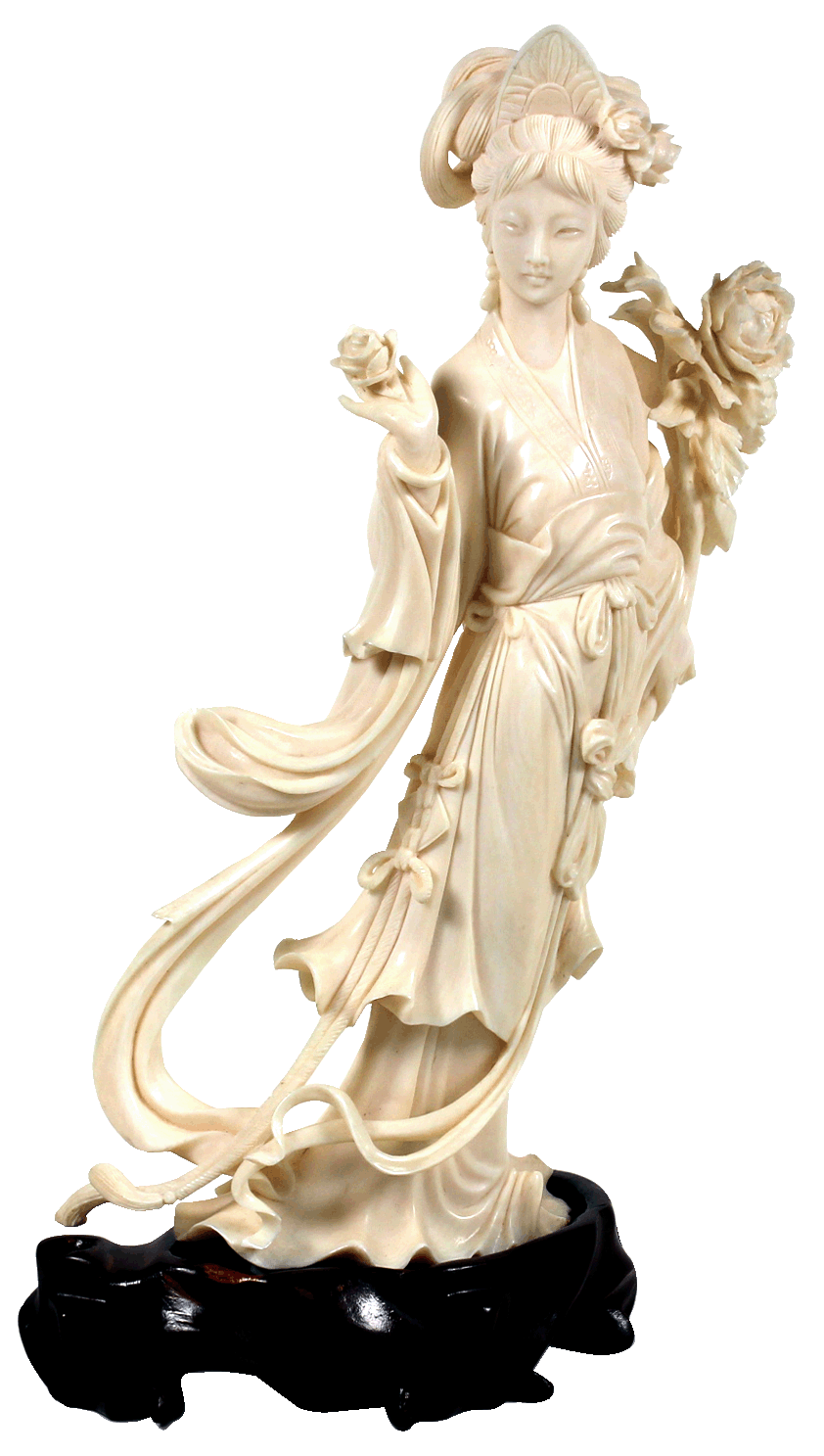
Ivory figurine, owned by author.
We Agreed
The international community has been diligently working on curbing and halting the killing of elephants. Unlike other endangered species, elephants have a strong commercial trade for their ivory tusks. An establishment called CITES is the frontrunner of the movement and namesake of the international treaty banning the import and export of elephant ivory.
CITES is an acronym for the Convention on International Trade in Endangered Species of Wild Fauna and Flora. It's is an international agreement between governments- an international treaty - and covers many species beyond just elephants. Even though CITES is legally binding on the signatory countries, it does not replace national laws. Thus, it is an agenda to be embraced by each country, which in turn implements national law to support the treaty.
The treaty covers exporting, importing, and re-exporting into the world market. To be able to trade internationally, a CITES permit is required.
Taking It a Step Further
U.S. federal law1 is straightforward - no commercial importation of ivory is allowed. Ivory that is part of a musical instrument, or a component of a traveling exhibition, a hunting trophy, a scientific specimen for law enforcement, or worked ivory that is part of a household move or inheritance that was removed from the wild prior to Feb. 26, 1976 (African elephant ivory) or July 1, 1975 (Asian elephant ivory) is allowed to be imported or exported under an Endangered Species Act (ESA) permit.2 Ivory that qualifies as an antique - 100 years or more in age - is exempt from interstate commerce, but ESA rules apply, though a permit is not required.3
The dates to remember as a personal property appraiser who renders reports for obtaining an ESA permit are the ivory importation 1990 date (intrastate for African ivory) or the ivory importation 1975 date (intrastate for Asian ivory), and the 1976 legally imported date (interstate). The ivory can then be sold interstate (between states). But what about intrastate sales (within a state)?
No Fake IDs Allowed
Before one can understand the methodology, some rules need to be detailed. An antique is classified as 100 years old. Circa dating, among appraisers, traditionally allows plus or minus 10 years. But precise dating is a requirement in dating elephant ivory. To obtain a CITES or ESA permit for an antique ivory item (even part ivory), the appraiser must be certain the item is 100 years old or older; if the item is 99 years old, it will not be considered an antique. This can be accomplished by scientific testing, a convincing trail of historical paperwork such as a dated photograph, or an appraiser's formal statement.
"We need to learn from ivory laws that call for an antique definition of 100 years. Don't wait for laws to be enacted. If it's made from an animal or possesses an animal part, document it now, and as an appraiser your report can be proof of age for future directives," advised Geoff Nelson, GIA GG, NAJA SM, JIAI CIA.
Crossing the Line
Federal law allows one to sell African ivory within their state, but the seller must prove the ivory was lawfully imported prior to Jan. 18, 1990. A CITES pre-convention certificate will suffice, as will a dated photograph, a dated letter, a document mentioning the ivory item, or other reliable proof.4 For sales within one's state, no permit is required at the federal level. However, some states have enacted laws restricting the sale of ivory.
Federal law prohibits sales of African ivory across state lines. Of course, there are some exceptions, such as antiques as well as some items that contain a de minimis amount of ivory. The term de minimis means a small amount. To qualify for the de minimis exception, (1) the item must be located within the United States and the ivory imported into the U.S. prior to Jan. 18, 1990 or imported into the U.S. with a CITES permit with no limitation on its commercial use; (2) if the item is located outside the United States, the ivory was taken from the wild prior to Feb. 26, 1976; (3) the ivory is part of an item and is not more than 50% of the volume or value of the item; (4) the ivory is not raw; (5) the total weight of the ivory component or components is less than 200 grams; and (6) the item was manufactured or handcrafted before July 6, 2016. The de minimis qualification only applies to African elephant ivory. One can move hunting trophies, household items, inherited items, scientific specimens, and items for law enforcement but not sell them across state lines unless the state has laws blocking these exceptions.
Another federal exception covers items that have been repaired with ivory: they must have been repaired before Dec. 27, 1973. The federal law is loaded with exceptions and subsequent details involving the exceptions. For example, to import antique ivory, one must declare the ivory with the U.S. Fish & Wildlife Service Office of Law Enforcement. And it must enter through a designated "antique port."5 U.S. Customs and Border Protection designated 13 ports for the entry of antiques made of ESA-listed species on Sept. 22, 1982, including Boston, New York, Philadelphia, Miami, and Los Angeles.
Is That All?
Just when you think you have mastered international and federal rules, exceptions, and quirky details, you will learn that the states have laws or have no laws of their own. Part II of this article will detail the various states' laws as well as what valuations gemologist-appraisers can render.
Written by Bill Hoefer

|

|

|
|

|
|
1. 50 Code of Federal Regulations § 17.40. Back to Text ↑ ↑ ↑
2. 50 C.F.R, § 17.40 (3)(E)(ii). Back to Text ↑ ↑ ↑
3. FWS Form 3-200-3a (Rev. 12/2021); 50 C.F.R. § 17.40(e)(9). Back to Text ↑ ↑ ↑
4. 50 C.F.R, § 17.40 (3)(E)(i). Back to Text ↑ ↑ ↑
5. 19 C.F.R. § 12.26. Back to Text ↑ ↑ ↑
6. Published in Gem Guide, November-December 2024, Volume 42, Issue 6, pages 22-23.
7. Article illustrations by Bill Hoefer.
8. Other illustrations - IStock.com.