
Are the USPAP standards required for estate appraisals? Appraisers that undervalue an estate can be subject to fines by the Internal Revenue Service. Fair market value is greatly misunderstood on meaning and methodology and is not always the price realized at auction.
Remember your draconian teacher that changed the rules on homework? She demanded that you write your first and last name in the upper left-hand corner of your homework papers. Additionally, you had to add the assignment title, class period, and date. Not any date but one that had a formal format with the month spelled out. If you did not do so, she either reduced your grade a level, gave you an F, or returned the paper as incomplete! But wait, was she preparing you for that day when you would be rendering an appraisal for estate tax liability?
It Is a Priviledge to be Taxed
Most appraisers understand that estate appraisals are for a settlement of a decedent's estate. Well, yes and no. An estate could be settled merely by dividing the property amongst the heirs. But there is a most important second reason for having an appraisal - to determine tax liability. There are two types of taxes, namely estate taxes and inheritance taxes. Estate tax is a tax on the privilege of settling one's estate after one has died and lost control of handling their estate. Inheritance tax is a tax on the privilege of receiving property from an estate.
The state courts handle the settling of estates.1 There is a federal estate tax but not an inheritance tax. And, yes, some states have an estate tax, and some states have an inheritance tax. If the estate pays federal estate taxes, a pickup tax exists for the state where the probate was handled. Thus, even in states claiming they do not have an estate tax, there is a hidden kickback if federal estate taxes are paid. From an appraiser's point of view, the estate tax liability appraisal must comply with both federal and state requirements.
Double Dating
Whenever one encounters appraisal assignments involving two jurisdictions, expect differences. If the date chosen for federal tax liability is the alternate date and the state of jurisdiction does not offer an alternate valuation date, then the appraisal must have two values for two effective dates. Yes, not only can there be a difference in effective dates, but also in value definitions. Yes, the state can have a value definition that is different than the federal definition. The estate tax liability appraisal could additionally be required to follow two value definitions - a valuation foursome.2
What's Fair?
Although there exist other value definitions, the fair market value definition mandated by the Internal Revenue Service (IRS) is often defaulted to by the states. The "willing buyer and seller" portion is found in almost every fair market value definition and is no surprise. However, the IRS fair market value definition for estate tax liability has a slight twist. It also seeks " . . . the fair market value of such an item of property is the price at which the item or a comparable item would be sold at retail."3 This basically asks for the ultimate consumer who will not alter or resale the item.
Golfing Around
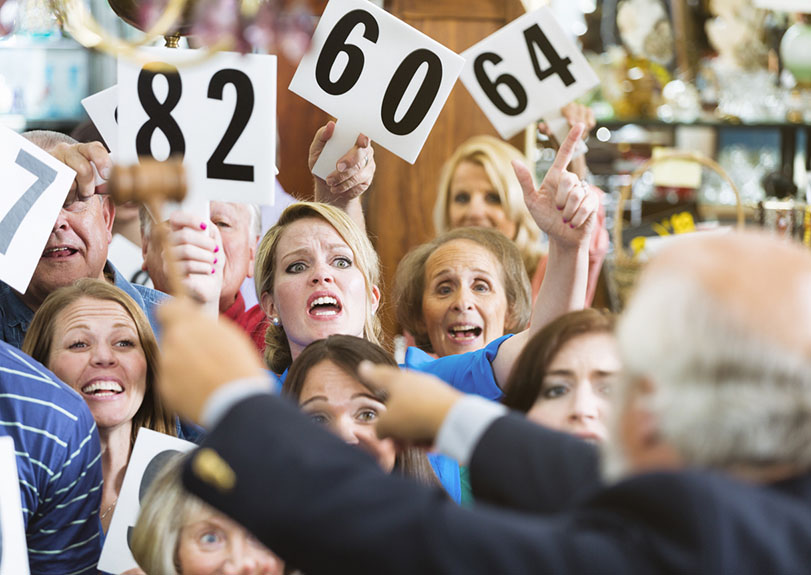
Avoid the sand trap of defaulting to auction sales to determine fair market value. Dealers who buy from auction will resell to the public, thus the ultimate consumer is the estate dealers' customers. Only if you know that a private4 is the buyer and not a dealer can you use the sales data. Or as one precedent setting case involving jewelry sales at auction opined, "We also do not know, for example, whether the bidders at the auction consisted of actual consumers who were willing to buy an item at its fair market value or. . . primarily dealers who bid substantially less than fair market value in order to resell their purchases at fair market value price which, to them, would be inclusive of a businessman's profit. In fact, we know little about the composition or number of bidders at the auction, let alone the tone of the actual bidding that took place. On the record before us, we simply cannot conclude as to any of the six items in question that the auction market is the 'market . . . in which such item is most commonly sold to the public.'5
Who is Qualified?
If you are on any appraisal discussion forum, you will encounter appraisers stating that to be an IRS qualified appraiser you must be in Uniform Standards of Professional Appraisal Practice (USPAP) compliance.
The basis for such a claim usually references IRS publication Substantiation and Reporting Requirements for Cash and Noncash Charitable Contribution Deductions. The publication, not specifically for estate tax liability valuations but charitable donations does not state a mandatory compliance but instead declares, "Accordingly, the final regulations do not adopt the recommendation to require strict compliance with USPAP and retain the requirement of consistency with the substance and principles of USPAP."6 Thus, for IRS charitable donations, USPAP is not required. What about estate tax liability?
A precedent setting published tax court case7 about estate tax liability made this clear when it stated "Uniform Standards of Professional Appraisal Practice (USPAP) are promulgated by the Appraisal Standards Board of The Appraisal Foundation, a nonprofit organization comprised of other nonprofit organizations that represent appraisers and users of appraisal services. Petitioner argues that Mr. [name redacted] direct testimony is unreliable because in various respects it is not in compliance with USPAP."
"USPAP is widely-recognized and accepted as containing standards applicable to the appraisal profession. Adherence to those standards is evidence that the appraiser is applying methods that are generally accepted within the appraisal profession. Therefore, at a minimum, compliance with USPAP is an indication that the appraiser's valuation report is reliable. However, a noncompliant valuation report is not per se unreliable. Full compliance with professional standards is not the sole measure of an expert's reliability."
"Petitioner has not cited any authority, nor do we know of any, for the proposition that an appraiser's compliance with USPAP is the sole determining factor as to whether an appraiser's valuation report is reliable. This and other courts have found that an expert's valuation opinion that does not fully comport with USPAP is still admissible although it may or may not be helpful."
"Therefore, we decline to adopt USPAP as the sole standard for reliability of an expert appraiser under Rule 702 of the Federal Rules of Evidence."
"Mr. [name redacted] direct testimony is the product of the application of reliable principles and methods of valuation to sufficient facts and data (as we shall discuss). It is admissible as expert testimony pursuant to Rule 702 of the Federal Rules of Evidence. Petitioner's objection to the contrary is overruled." 8
What Rules?
Thus, USPAP is considered excellent but not mandatory in both IRS charitable donation as well as estate tax liability assignments.
The Federal Rules of Evidence is clear when it spells out what a qualified appraiser is. They state "A witness who is qualified as an expert by knowledge, skill, experience, training, or education my testify in the form of an opinion or otherwise if: (a) the expert's scientific, technical, or other specialized knowledge will help the trier of fact to understand the evidence or to determine a fact in issue; (b) the testimony is based on sufficient facts or data; (c) the testimony is the product of reliable principles and methods; and (d) the expert has reliably applied the principles and methods to the facts of the case."9 Wow, almost every appraiser seems to be qualified.
Hang onto Your Assets
Gemologist-appraisers who testify as expert witnesses soon discover the legal pre-trial exchange of evidence between parties, called discovery:
There is always a catch. And the IRS has one for appraisers. They have a fine for appraisers who mess up!
The limbo dance bar for being qualified may be high for even a tall drunken old appraiser to pass under, but that is balanced by the penalties for an undervaluation of estate property. If you read the IRS guidelines for penalties, they include estate tax valuation understatement as included in the penalty.10 Thus, if the property is appraised at 65% or less than the amount determined to be the correct amount,11 the penalties will be forthcoming. Notice that it is undervaluation! IRS could care less if you over valuate an estate property as that is to their benefit. It states, "The amount of the IRC 6695A penalty is the lessor of: (a) The greater of: 10% of the amount of the underpayment or $1,000 or (b) 125% of the gross income received from the preparation of the appraisal."12
Okay, we now know that USPAP is not required for IRS charitable donation and estate tax assignments. But wait, think of standards like a seat belt. If you have an accident, the seat belt will noticeably lower your odds of serious injury. Thus, complying with a set of standards coupled with an appraisal education is the key to avoiding writing a check to the IRS. Hats off to your draconian teacher who changed the rules on homework!
Written by Bill Hoefer

|

|

|
|

|
|
1. The probate courts. Back to Text ↑ ↑ ↑
2. This methodology discovered and developed by the author is called the Broad Market Value Definition Rule. Back to Text ↑ ↑ ↑
3. 26 Code of Federal Regulations § 20.2031-1(b). Back to Text ↑ ↑ ↑
4. A private is a non-dealer buying at auction. Back to Text ↑ ↑ ↑
5. T.C. Memo. 2004-27, 2004 WL 205824, 87 T.C.M. (CCH) 851, T.C.M. (RIA) 2004-027, 2004 RIA TC Memo 2004-027. Back to Text ↑ ↑ ↑
6. 83 FR 36417 section B. Back to Text ↑ ↑ ↑
7. Called case law. Back to Text ↑ ↑ ↑
8. 131 T.C. No. 10, 131 T.C. 112, Tax Ct, Rep. (CCH) 57,572, 77 Fed. R, Evid. Serv. 1342, Tax Ct. Rep. Dec. (RIA) 131.10. Back to Text ↑ ↑ ↑
9. The Federal Rules of Evidence, 702 Testimony of Expert Witnesses. Back to Text ↑ ↑ ↑
10. Internal Revenue Bulletin 20.1.12.3. Back to Text ↑ ↑ ↑
11. Internal Revenue Code § 6662(G). Back to Text ↑ ↑ ↑
12. Internal Revenue Bulletin 20.1.12.3. Back to Text ↑ ↑ ↑
13. Published in Gem Guide, November-December 2022, Volume 41, Issue 6, pages 17-18.
14. Illustrations - IStock.com.