
HIGH MARKS - Gem Guide, May - June 2008
So, you've always dreamed of owning an authentic Lalique plique à jour enameled dragonfly brooch with opal hind wings and eyes of demantoid garnets. In this desire you are not alone. It is classic jewelry at its finest. More color than a tie-dyed tee-shirt and more artistic than Salvador Dali's melted clock painting. What has put you and me into dream-land is an aspect of value called "marketable provenance."
When researching the worth of an item, one must determine the elements of value for the particular item. For example, the elements of value for a diamond would be the Four Cs - although additional elements of value also exist for diamonds.
Provenance can also be an element of value. However, provenance's influence on value comes into play only when it is marketable. Provenance is usually thought of as the history of a piece, such as would exist if a famous person once owned it. In the case of prior ownership by someone (or an entity) that influences the value, researching similar items owned by the famous person or people of similar marketability is appropriate. For example, Elvis as a previous owner would change the value.
©
Yes, a copyright on an item can be classified as a form of provenance. There are two types of copyrights, name ly those involving written works and those involving visual works. There are two ways to copyright an item, either by registering the copyright with the U.S. Copyright Office or merely marking it as copyrighted. With the later approach, one may not be able to sue for damages or lodge their case in a federal court. In other words, legal resources may be limited, if not hampered. Copyright provides the copyright holder the right to limit who can produce the item. If you copyright a ring design and decide that only your store will sell it, then your store is the only entity authorized to produce it and market it. An insured item that holds a valid copyright can only be replaced through those who are authorized by the copyright holder to reproduce or distribute it.
The Whole of It
Indemnity exists when an insured that experiences a casualty loss is "made whole" (returned to their pre-loss state). In the insurance world, this can best be summed up as "achieving indemnity." In other words, the insured is not to make a profit or experience a loss, but be made equal to what they enjoyed just prior to the casualty loss event - usually in terms of money. Indemnity is a maxim of the insurance industry that has a basis in the law. Anne Blumer, GG, ISA, specializing in insurance methodology advises, "Never should a valuation report undermine the principle of indemnity. Instead appraisals must fully describe the item and present a value that is not inflated or deflated." According to Anne, indemnity is the basis of all insurance policies and therefore should be the basis of all appraisals. By the way, indemnity also involves accompanying laboratory reports.
In researching value, it matters not what anyone could knock off an item for, but rather it is what the authorized makers and distributors sell it for that counts. This makes value research easy. Merely seek out the sellers that are authorized to sell the copyrighted item and you have the value.
Insurers are also obligated to replace copyrighted pieces in the same manner. This is a legal matter and knock offs are not legal for them to explore. If your store has a valid copyright on a design and it is only sold through your store, your achieved sales are the value. Others appraising the same item must also use your accomplished sales for determining value. Copyrighting your designs not only protects the designs from knock offs but also compels replacement through your store. Copyright your designs!
Branding Irons
Appraisers can research a brand in much the same way as they do copyrighted items. For instance, if a piece has the David Yurman® brand stamped on it, then seeking the same item or similar items by David Yurman is prudent and correct - depending on availability in the market. Again, knock offs are not allowed be careful not to allow counterfeits to become part of your data.
Consumers buy jewelry with certain brands (trade marks). Consumers are restricted to purchases for copyrighted items in authorized outlets. Consumers will pay a different price for an item with marketable provenance. Therefore, even though these are legal requirements that directly influence value, the marketplace has the very same influences so consequently the results are the same.
Patent Applied For
What about patent numbers? As far as value, items with comparable patents are less mandatory to match in the market. In practice, patent numbers are mostly used to determine a circa date. A circa date is not the date the item was made but a historical marker as to when approximately the item started to be made. Vintage pieces with patent numbers that translate to a date analogous to the determined date of manufacture collaborates the age of the item.
Therefore, a patent date may be 1927 and stamped on a contemporary item simply because the manufacturer has not retooled their dies. However, the 1927 date does indicate that the item cannot be from the 1890 era. They are a historical threshold of "it had to be made near or after" the patent date. In other words, circa dates derived from patent numbers indicate age and must be considered along with other indicators before an actual circa date can be determined.
Cut Off Your Ear, Why Don't You
If you make jewelry, whether you call it custom work or designing, you know that it really is an art form. But are you an artist or an artisan?
There is a market for artist rendered jewelry that most do not realize exists. Art jewelry is sold, for the most part, in galleries. Pieces are signed by the artist and sometimes numbered to demonstrate the total number of pieces made. If the artist is recognized, his or her pieces will be sought by collectors. This is marketable provenance.
The works of artisans are not sought by collectors because of who made it. Artists are recognized as artists by consumers where as artisans are not. Compare it to paintings. Some paintings are rendered by artists who display in galleries, are noted by auctions featuring their works, and so forth. Paintings rendered by artisans are considered decorative art and not fine art. If you are in an art gallery considering acquisition of a painting, you will ask about the artist. If you are in a department store, you will most likely not pay attention to the signature. As an appraiser, you will need to determine if a signature is by an artist or an artisan. A goldsmith signing his pieces does not make him an artist. Artists are recognized by the marketplace.
Tell It Like It Is
If the value was a result of marketable provenance then state it in the cover letter. Mention copyrights, brands, provenance and even patent numbers. Likewise, in the item's description, state all the elements of value such as copyrights, laboratory reports, brands, etc. Failure to state all elements of value in an item's description is to fall short of due diligence. Your task, in an appraisal for obtaining insurance (to name one specific example from many assignments) is to be clear what the insurer must do to achieve indemnity.
Written by Bill Hoefer

|

|

|
|

|
|
1. Published in Gem Guide, May-June 2008.
2. Illustrations - IStock.com.
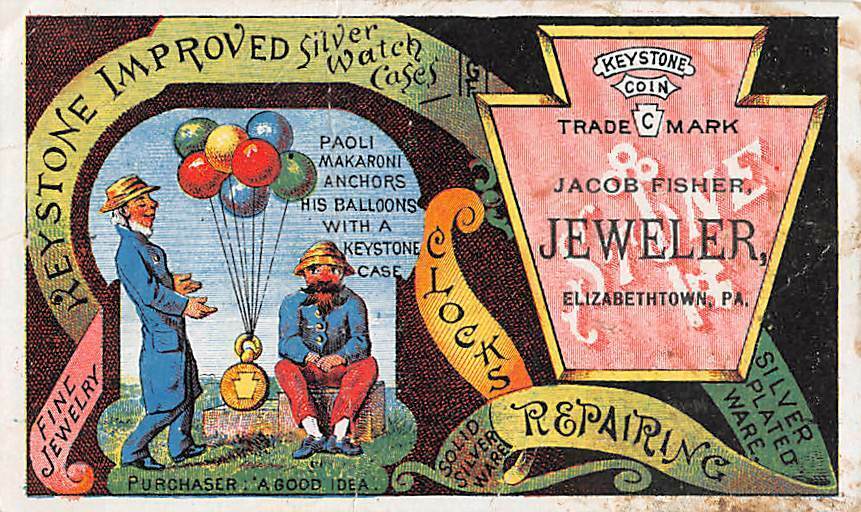
3. Illustration - Antique post card owned by author.