
WHAT a REVOLYING IDEA - a COVER LETTER - Gem Guide, January - February 2008
During the 1980s, a revolution swept through the jewelry appraisal profession and the cover letter became standard appraisal practice. It seemed that every course, seminar and book endorsed the use of a cover letter (now refered to as Supplemental Information Letter).
Now there seems to be a counterrevolution. Those opposed to the use of cover letters argue that they are not necessary for the ubiquitous insurance appraisals rendered with such regularity by the average gem and jewelry appraiser
After all, they reason, it is only an insurance appraisal and not something intended for litigation or a legal hearing. Still others suggest the cover letter is merely a means to present a series of all-encompassing disclaimers. Moreover, some valuators see it as puffery - a way to justify the high fees charged for an appraisal by showing the client the thickness of the appraisal.
On the other hand, some proponents of the cover let ter are pushing for it to be a standard.
The National Association of Jewelry Appraisers (NAJA), the jewelry industry's largest appraisal group, embraces the cover letter as a standard. The association has a minimum standard composed of fifteen required elements that must be in the cover letter or within the narrative to be in compliance.
Last April a request was made for all members to renew their files with a current insurance and fair market value appraisal - reports that will also be reviewed internally. "Members of the NAJA must now provide an updated copy of their appraisals, including the cover letter, to the association by December 31 of 2007," reported Gail Brett Levine, Executive Director of NAJA, a Graduate Gemologist (Gemological Institute of America) and practicing independent appraiser.
Most members have acted in accordance with the request and Gail is impressed on the thoughtfulness these members have put into organizing their cover let ters' clauses to be understandable and logical - they were not just a jumbled list of elements.
When asked what she thought about appraisers who think a cover letter is optional or should not be used, she steadfastly countered by stating , "An appraisal's cover letter is really the DNA of an appraisal report.”"Gail explains that cover letters provide cohesiveness and a check list for important elements necessary to eliminate confusion. She emphasized that a discussion of markets as linked to the types of items, the scope of the appraisal assignment, definitions of the values reported and important dates - to name a few of her points - are requirements that have been diligently researched and developed by appraisal method ology experts over the last twenty years. She is now making that evolution of standards a NAJA standard.
Avoid the Blind Date
An appraisal's function is to convey to the users of the report all information about the item in addition to a conclusion of its worth. It could be argued that information about the specific item is within the item's detailed description. If that is true, then what does a cover letter convey?
An important aspect of an appraisal is to clarify the dates involved in the valuation process. For example, is the date on the report the date when it was printed and signed? Or is the date the date-of-inspection? For an appraisal used for obtaining insurance, value is linked to the date-of-inspection and not the date-of-rendering unless, of course, they occur on the same date.
Abuse can occur if dates are nebulous. For example, if an item is lost after inspection but before the report was completed and delivered to the client, the client can claim they still had it when they insured it by merely pointing to the date-of-rendering as if it were the date-of-inspection.
Who is on First?
The fraternal twins of the cover letter are called "purpose" and "function." Disregard Webster's Dictionary definitions as these are trade parlance. "Purpose" is reporting a value definition (i.e., " . . . for the purpose of determining fair market value") while "Function" is the intended use of the report (i.e., " . . . determining tax liability for a charitable donation"). Or is it the other way around? Even highly trained appraisers have difficultly remembering which is which.
Worse yet, anyone outside the appraisal arena will assume them to be synonymous.
Ralph Joseph, ISA-CAPP, author of The Jeweler's Guide to Effective Insurance Appraising, suggests the use of "Purpose" and "Assigned Use" to limit the confusion.
The actual cover letter clause would state, "This appraisal report, covering one jewelry item is prepared for the purpose of estimating the retail replacement value of the item described herein, solely for the assigned use of obtaining or renewing insurance."
Exculpation Clauses
Most of us have seen the all-encompassing disclaimer that tries to sidestep liability. Remember the commonplace appraisal phrase "We assume no liability for any action taken on this report?" Well not so fast. This is merely a paper shield and can be easily pierced by even the most incompetent attorney. Under specific circumstances, such a statement might withstand a legal attack if it were read, understood and agreed to by the client - but that is a set of rules and circumstances that should not be counted on. In other words, sneaking such a clause into an appraisal is a waste of your inkjet cartridge.
Therefore, the days of the all-encompassing disclaimer have past. The current era can be summed up as Limitations, Limitations, and more Limitations.
Instead, professional appraisers state the limiting conditions that existed. Do you, as do many appraisers, inspect the items by appointment (while the client is present)? Do you encounter gems so small that you could not properly test and identify them? Do you examine a diamond set into six prongs and discovered no inclusions or blemishes but hesitate to call it flawless? Do you rely on the stamp indicating the quality of metal? Do you measure the gemstone and estimate the weight from a trade accepted formula? Those all are limiting conditions that need to be stated in the appraisal report. In essence the reason for limiting conditions is to convey to the client what you did and did not do, and what you know and do not know about the item.
For instance, you may want to include a time limit on the report. No, that does not erase liability for a lack of due diligence after the expiration date occurs. Instead it forces the client to reappraise the item. Each day, it seems, we learn about a new clarity or color enhancement - or worse yet, that a new synthetic has been discovered after years in the marketplace. These gemological nightmares exist and are a real concern. Reexamining an item with new knowledge is proper and acceptable.
Gail Levine suggests to appraisers, " . . . do not take short cuts or assume anything." After which she quickly added, "And make sure that a statement in the cover letter actually has a counterpart among the appraised items." In other words, to have a clause about watches and not have a watch listed within the items valuated sends a message of sloppiness.
So Where to Start?
Phone an appraiser who has an impressive cover letter and rip it off. Then when the day finally comes that you must testify, expect the cross-examining attorney to ask you to explain the various clauses within the cover letter. Gulp! You haven't a clue what all that legal-mumbo jumbo means. A bad experience in the witness stand is like taking the final examination and then seeing the lessons afterwards for the first time. Both can be career changing experiences . . . literally.
Instead, Raymond Mason GG, GIA, CEO, Arizona Gemological Laboratory, Inc., recommends, "Get some worthwhile appraisal training, read valuation books and articles, attend educational seminars and join an appraisal society." When asked about his cover letter, he responded "Which one? Each different valuation assignment demands a different cover letter - and I am not talking about small things like dates either." For example, he has multiple cover letters for determining tax liability - one for the federal government as well as one for each of the states in which he renders reports.
In Conclusion
A cover letter provides the end user and appraisal client information they need to know when making decisions based on the report. Moreover, a cover letter prevents misunderstandings. The days of the one page appraisal are gone. Consequently, a proper cover letter accompanying an insurance appraisal is compulsory.
Written by Bill Hoefer

|

|

|
|

|
|
1. Published in Gem Guide, January-February 2008.
2. Illustrations - IStock.com.
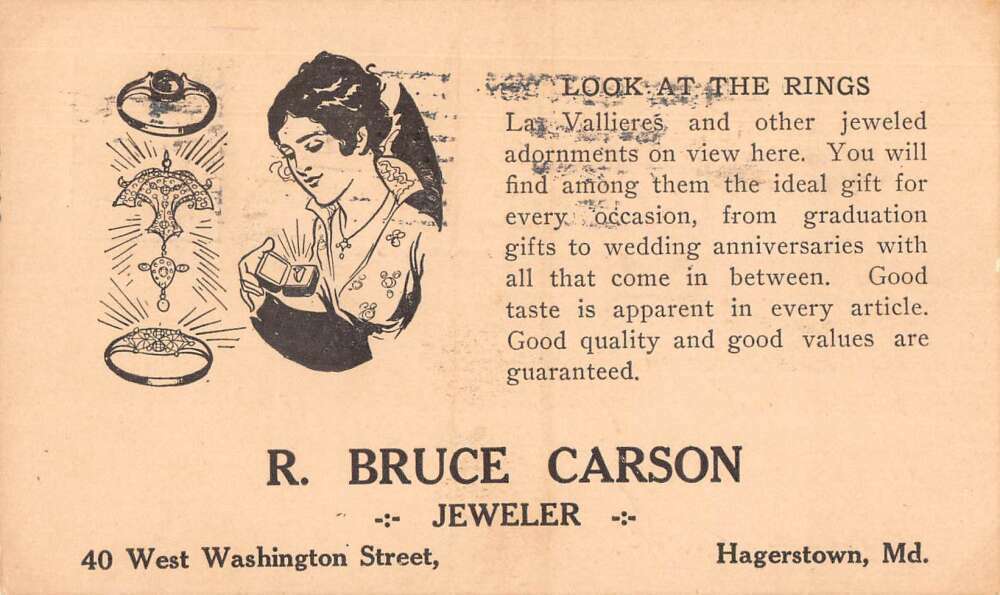
3. Illustration - Antique post card owned by author.