
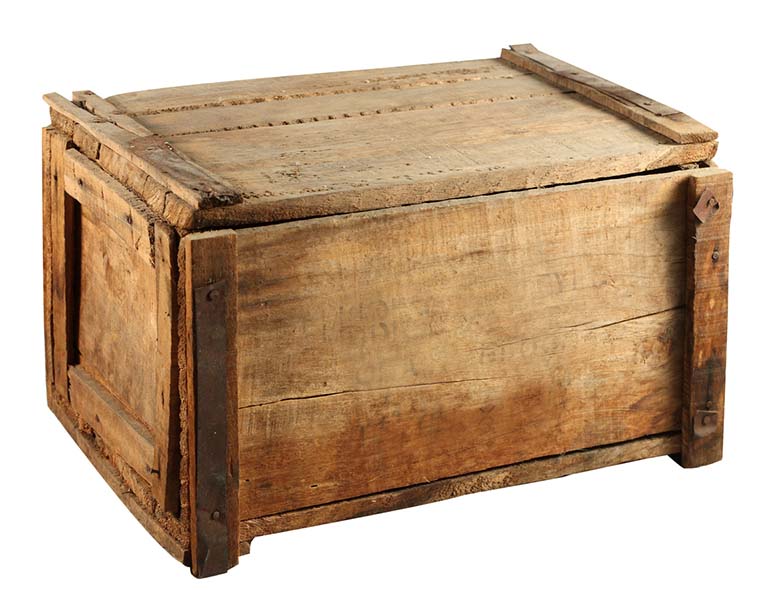
Sometimes appraisers forget to work within boundaries to achieve success. Since we are related to the jewelry trade, gemologist-appraisers might want to think broadly inside the box. Thinking broadly inside the box is what Henry Brown, a Virginia slave, did by successfully mailing himself in a 3 x 2.67 x 2-foot box to freedom in 1849!1
First Think Broadly
Many appraisers feel that they must make only one decision with the identification, quality, or value conclusions. The decision will not only affect the appraisal client but also third parties who are authorized to rely on the appraisal. If the appraiser is not sure that the gemstone, is enhanced, or from a particular country, or has a certain color grade, or weighs more or less than a carat, and a myriad of other "what if" possibilities . . . which possibility does the gemologist-appraiser report?
Additionally, appraisals may have difference-of-value conclusions based on various value elements choices. Does one ignore, for example, opposing expert opinion and only report their own? Invented by the insurance arena but so useful for all appraisal assignments is a valuation methodology tailored for handling two or more valuation decisions. It is time to climb inside the box.
Broad Evidence Theory2
In some jurisdictions, when a casualty loss occurs and it ends up in an appraisal dispute panel, any evidence that would shed light on value can be presented in determining actual cash value. Thus, the Broad Evidence Rule is used. Rather than merely following the formula of determining retail replacement minus depreciation and obsolescence, the courts want all value evidence.3 One court stated, " . . . The Broad Evidence Rule permits the consideration of all evidence logically related to the formation of an accurate estimate of the value of the destroyed or damaged property, for the purpose of ascertaining the 'actual cash value' at the time of the loss. In applying this rule, it is not necessary to abandon consideration of either market or reproduction values, but they must be viewed merely as guides and not the sole determinative in arriving at 'actual cash value.'"4
The goal of insurance is to achieve indemnity. The Broad Evidence Rule allows the court the ability to select a value that best achieves that goal outside the bounds of a contractual formula. The goal of indemnity is the same goal that a gemologist-appraiser rendering valuations for insurance must achieve in their value conclusion.
What Value Evidence is Reviewed by the Courts?
The acquisition cost, fair market value, cost of replacement, cost of reproduction, cost of reconstruction, value to owner, and value in use are all acceptable to consider by courts or hearings seeking Broad Evidence in states that embrace the Broad Evidence Rule for insurance settlements. But Broad Evidence is a methodology that also can be used in non-insurance settlement assignments.
Appraisers wishing to excel in personal property appraisal theory must apply the Broad Evidence Rule whenever possible. The Broad Evidence Rule avoids both dilemma and inferences of negligence. The Broad Evidence Rule, in anticipation of litigation is the uppercut punch of professional appraisers. Let the trier of fact5 or arbitrator select the one that will achieve indemnity.
In Practice
So how does the Broad Evidence Rule work in actual appraisals? What happens if you are presented a laboratory diamond grading report that you disagree with? Dissenting opinions are easily handled by applying the Broad Evidence Rule. Just report a value conclusion for the laboratory report and one for your quality opinions. Yes, some appraiser gurus advise appraisers to ask the client if they want to insure the items with the laboratory report or not and then use that client-decision to report a value conclusion. Why not just report the two outcomes and let the client and his or her insurance company discuss and decide the best route? It is better for the insurer to advise the insured-to-be which outcome is best.
Effective expert witnesses know that litigation appraisals involving hypothetical details are best handled by applying the Broad Evidence Rule. What if the opposition questions if the diamond in the missing ring was manmade? Report a value for both options. Again, let the trier of fact or arbitrator decide what value to use.
Broad Market Value Defintion Theory6
Lawsuits can be the most demanding on professional gemologist-appraisers. The various laws, regulations, published court setting precedence cases7 all serve to guide and mandate effective dates and value definitions. Lawsuits have what are called causes of action. A cause of action is what the lawsuit is about. For example, fraud would be a cause of action. The gemologist-appraiser must match the report's effective date and value definition to the one required by the cause of action in the jurisdiction applicable. If the case is for a conversion8 in a Maryland case, the effective date is date that the property was converted, and the value definition is fair market value.9
The hurdle is just one in a series that a typical lawsuit has since there are usually more than one cause of action. Each cause of action has a mandatory effective date and value definition. Hence, the gemologist-appraiser must report several effective dates and value definitions to comply. Breach of bailment, breach of contract, fraud, misrepresentation, and conversion would be the basic causes of action in a diamond that was supposed to be recut but instead was switched.10 Just to provide a slight hint without discussing a complicated appraisal scenario, breach of contract would likely require the value be based on recut on the day of promised delivery, whereas the other effective dates would likely be the date of the incident.11 By the way, appraisers who appraise property involved in trusts and estates; conversion is commonplace cause of action by lawful beneficiaries.
Let the trier of fact decide which specific value will be the basis for compensation. Just report all the variables as required.
Think Inside the Box
Like Henry 'Box' Brown, take the valuation tools available and put them to use. The box is not only sized for your appraisal needs but embraced by the legal arena. The approach is also tailored to lessen the liability of the appraiser by placing the onerous of decision making back onto the client and approved third parties. Basically, an appraisal must convey all information, good and unpleasant, to the parties. The two "broad" methodologies fulfill that requirement.
Whether you are rendering appraisals as an expert witness or just commonplace obtaining insurance valuations, think broadly inside the box!
Written by Bill Hoefer

|

|

|
|

|
|
1. Henry 'Box' Brown, circa 1815 - 1897. The box traveled by wagon, railroad, steamboat, and ferry from Virginia to Maryland. After achieving
freedom, he became a professional magician. His first magic trick, the great mail escape, however, was an illusion that had no audience and one that even the famous escape artist Houdini would have dropped his jaw in amazement. Brown later wrote, "If you have never been deprived of your liberty, as I was, you cannot realize the power of that hope of freedom, which was to me indeed, an anchor to the soul both sure and steadfast." Back to Text ↑ ↑ ↑
2. First discovered and introduced to the appraisal profession by C. Van Northrup in his Insurance course taught by the International Society of
Appraisers (ISA) in the late 1980s. Back to Text ↑ ↑ ↑
3. 118 N.E. 574. Back to Text ↑ ↑ ↑
4. 187 A. 2d 49. Back to Text ↑ ↑ ↑
5. Judge or jury. Back to Text ↑ ↑ ↑
6. Developed by this author while researching value definitions and effective dates required by causes of action during an internship as a
paralegal in early 1990 and detailed in the Expert Witness course as written and taught by ISA starting in 1995. Back to Text ↑ ↑ ↑
7. Called case law. Back to Text ↑ ↑ ↑
8. "Any unauthorized act which deprives an owner of his property permanently or for an indefinite time." Black's Law Dictionary, Fifth Edition, page 300. Back to Text ↑ ↑ ↑
9. Vaughn v. Vaughn, 146 Md. App. 264 (Md. Ct. Spec. App. 2002). Back to Text ↑ ↑ ↑
10. Every jeweler's nightmare to be accused of switching someone's diamond. In this example, we will not use the criminal larceny but in
stead detail the civil lawsuit. Back to Text ↑ ↑ ↑
11. Depending on the state of jurisdiction. Back to Text ↑ ↑ ↑
12. Published in Gem Guide, May-June 2021, Volume 40, Issue 3, pages 14-15.
13. Illustrations - IStock.com.